


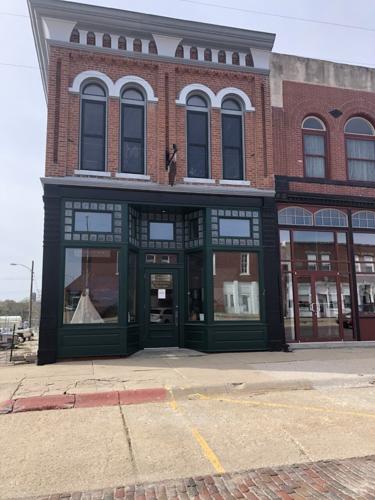
Tecumseh’s Cornerstone Building was built in 1890 on the courthouse square at the corner of Third and Clay Streets. In 2008, the dilapidated building was scheduled for the wrecking ball. A small group of local investors successfully appealed to the city government to save the building so it could be restored. Two talented individuals, Jim Borenpohl and Fred Pooch, provided volunteer labor and successfully met the renovation deadlines.
The renovated Cornerstone is now home to the Johnson County Nebraska Historical Society Museum. The dream that began with saving the building has grown into a destination for people interested in local history.
The Cornerstone was donated to the historical society in 2012 and officially opened as a museum on August 11, 2015. “We didn’t know that we had history until Sarah told us,” said Fred Pooch, one of the museum’s board members and an instrumental volunteer.
People are also reading…
Pooch was referring to Sarah Williamson, president of the historical society. The passion and determination of Sarah and her board of directors have transformed a building into a living museum filled with realistic displays of Johnson County history. “It has been an exciting and fulfilling experience that could not have been accomplished without the volunteers and support of our community.”
Honoring Johnson County history
Johnson County is named in honor of General Richard Johnson, who was alleged to be responsible for the death of the Shawnee Chief Tecumseh during the War of 1812. It is therefore fitting that the city of Tecumseh be named in honor of the chief.
It is also fitting that one of the museum’s display windows depicts a Native American scene with a mural painted by local artist, Amzie Dunekacke. The museum’s timeline continues through scenes and stories of pioneer settlers who endured the “Worst of Times,” including the locust infestation of 1875, the Blizzard of 1888, and the Dust Bowl of the 1930s.
A display depicting the passage of “The Orphan Train” through Johnson County led a local barber to discover that his mother was an Orphan Train passenger. Williamson said, “We were delighted when Jim Stauffer shared his thoughts, stories, and documents regarding his mother’s journey on the Orphan Train at one of our ‘Monday Night at the Museum’ presentations.”
Exhibits and veteran tributes
The museum has a special wing entitled, Honoring Our Veterans, For All Who Died, For All Who Carried On, History Will Not Forget. History from each war, beginning with the Civil War to the current conflicts, is depicted with mannequins in uniform, audio recordings, and displays.
Local resident Clarence Hupka was honored by the museum as one of only 317 survivors of a crew of 1,196 when the USS Indianapolis was sunk by a Japanese torpedo in World War II. At that time, Mr. Hupka was one of fewer than 40 remaining survivors.
The museum board is dedicated to providing more than a line of display cases. Each exhibit comes with a story depicting a period or event. Placards throughout the museum offer stories, while knowledgeable docents provide details.
“From the original Cornerstone Building, our campus has expanded to include seven separate facilities with an eighth in the planning stages,” Sarah Williamson said. “Each building has a separate theme and stories.”
Ladies are drawn to the re-creation of a wedding chapel that displays 22 wedding gowns donated by county residents. Men tend to focus on high school sports displays and agricultural equipment. Everyone is curious about the 1872 Johnson County Jail, a three-cell limestone edifice with no running water or electricity. The jail’s upper floor is where the county sheriff lived and enjoyed all the modern conveniences available at the time.
Agriculture, transportation, and education
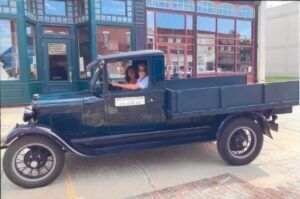
The agriculture and transportation building houses the original covered wagon in which the Buethe family traveled across America to Johnson County. A 1919 Ford Model AA truck was fully restored by Dan Svoboda and donated to the museum. An area devoted to the re-creation of a 1950s service station is popular. An amazing display of craftsmanship is the hand-carved reproduction of a farmstead that includes the home, outbuildings, livestock, and vehicles. Daryl Kruse devoted years as a hobby to creating this truly phenomenal display.
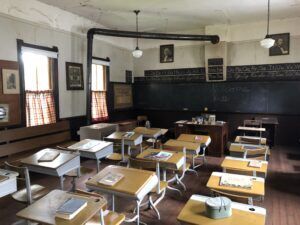
The Hedge Corner Country School was relocated to the museum campus in 2020. The one-room school has been restored to its original design and furnishings. A board member, Karen Johns, formerly taught in a one-room school and holds class in the Hedge Corner school each year for elementary students from the three Johnson County schools. In addition, Mrs. Johns, along with her husband Jim, have identified the site of each of 71 one-room country schools in the county and placed signage to identify those locations.
Programs and recognition
Programming is a major factor in the museum’s success. A popular series, “Monday Night at the Museum,” features guest speakers who have a tale to tell. Topics are wide-ranging and usually elicit more stories from the audience. These well-attended programs have led to the construction of the Johnson County Museum Education Center. This new area will be a permanent facility for “Monday Night at the Museum,” as well as a media center and research facility.
The museum’s success has been well documented. Pure Nebraska, a rural lifestyle show produced by Emmy Award winner Jon Vanderford, has featured the museum in four episodes. Two live interviews were aired on Lincoln television stations. The museum has been selected for the Nebraska Passport three times and Wander Nebraska twice.
“Our crown jewel of recognition was to be selected by the Smithsonian Institution to host its traveling exhibit, Crossroads: Change in Rural America,” said Williamson. “Just to be named in the same sentence with Smithsonian validates that we have come from a dream to a destination.”
“The museum is filled with memories and more to come as we continue to develop the education center and our agricultural building,” said Williamson. “What is most gratifying is that the entire project has been funded by donations and volunteer efforts. I am often asked how I get the volunteer support. The wonderful part of Johnson County is that volunteers merely appear and ask, ‘What can I do to help?’”
The Johnson County Museum is located in Tecumseh, Nebraska at the corner of Third and Clay Streets. The museum is open April 1 through November 30. Hours are 10 am to 2 pm Tuesday–Saturday.
-Johnson County Historical Society, April 2026


